Peptides in Skincare: What the Science Says
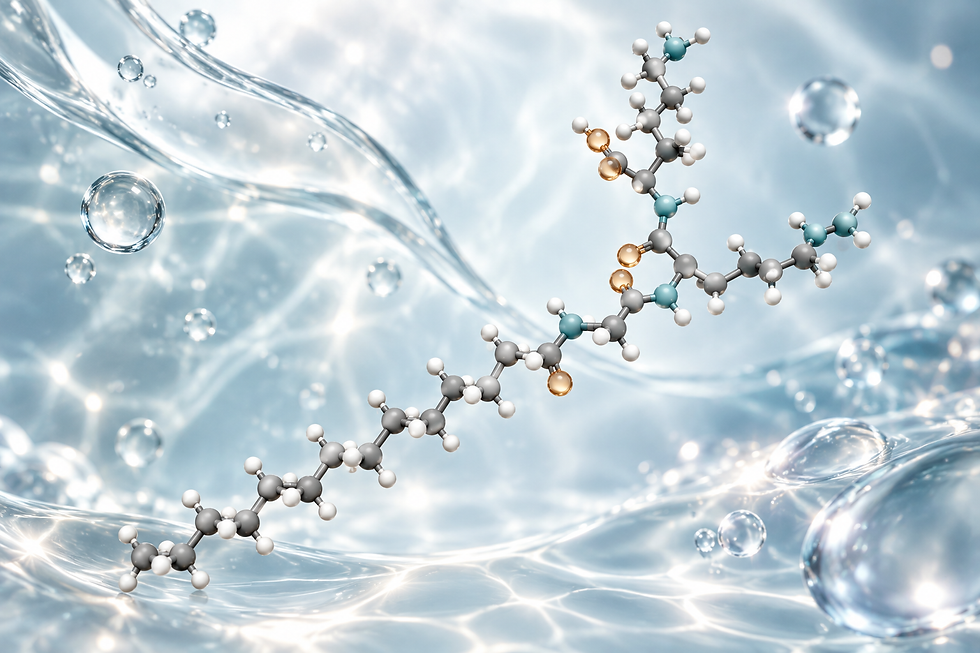
Peptides have become one of the most talked-about ingredients in modern skincare. They can now be found in everything from eye creams to firming serums, often accompanied by claims about collagen, wrinkles and skin renewal. But peptide is not one ingredient. It describes a large family of small molecules that can behave very differently depending on their structure, concentration and formulation. So what exactly are peptides, how do the different types work, and what can they realistically do for the skin?
What Are Peptides?
Peptides are short chains of amino acids, the same building blocks that make up proteins such as collagen and elastin. In skincare, particular peptide sequences are selected or designed because they may interact with biological processes involved in skin structure, repair or ageing. Some peptides act primarily as signalling molecules, others bind minerals such as copper, while another group has been developed to influence pathways associated with facial expression lines. This means that two products advertising “peptides” may contain completely different ingredients and have very different purposes (Pintea et al., 2025).
Peptide type | What it is designed to do | Common examples |
Signal peptides | Support signalling associated with collagen and the extracellular matrix | Palmitoyl Pentapeptide-4, Palmitoyl Tripeptide-1 |
Carrier peptides | Bind and transport minerals involved in biological processes | Copper Tripeptide-1 / GHK-Cu |
Expression-line peptides | Influence signalling associated with repeated facial movement | Acetyl Hexapeptide-8 |
Enzyme-modulating peptides | Influence pathways involved in maintaining or breaking down skin structures | Various specialised peptides |
These categories are helpful for understanding how peptides differ, although they are not completely separate. Some peptides can have more than one biological role.
Signal Peptides: Supporting the Skin’s Matrix
Some of the best-known skincare peptides are known as signal peptides. They are designed to imitate naturally occurring peptide fragments that can act as signals within the skin, including signals associated with fibroblasts and the extracellular matrix. A classic example is Palmitoyl Pentapeptide-4, sometimes known as Pal-KTTKS. In a 12-week placebo-controlled study involving 93 women, a moisturiser containing the peptide produced measurable improvements in signs of photoageing, including fine lines and wrinkles, compared with the control moisturiser (Robinson et al., 2005).
Newer cosmetic formulations often combine several signal peptides rather than relying on a single molecule. However, a longer ingredient list does not necessarily mean a more effective product: the concentration of each peptide, its stability and the formulation carrying it remain just as important.
What About Expression-Line Peptides?
Another popular category includes peptides such as Acetyl Hexapeptide-8, commonly associated with the ingredient technology Argireline®. These peptides were developed around pathways involved in neurotransmitter signalling and repeated facial movement, which is why they are frequently marketed for expression lines. They are sometimes described as “Botox-like”, but the comparison is misleading. A topical cosmetic peptide is fundamentally different from injectable botulinum toxin in its mechanism, delivery and strength of effect. A more realistic cosmetic goal is to help improve the appearance of expression lines, rather than prevent muscles from moving.
Research remains interesting. A 2026 clinical study of a serum containing Acetyl Hexapeptide-8 together with another peptide and several additional active ingredients reported improvements in both static and dynamic wrinkles over 12 weeks (Zhu et al., 2026). Because the formula contained several active ingredients, however, the effect cannot be attributed to Acetyl Hexapeptide-8 alone.
Copper Peptides: Why Are They Different?
Copper peptides are currently receiving particular attention in skincare. The best known is GHK-Cu, normally listed in cosmetic ingredient lists as Copper Tripeptide-1. GHK is a naturally occurring peptide consisting of three amino acids. When it binds a copper ion, it forms the GHK-Cu complex. Laboratory and biological research has associated this complex with processes involved in extracellular-matrix maintenance, tissue repair, collagen-related activity and antioxidant responses (Mortazavi et al., 2024).
This makes copper peptides scientifically interesting, but it also illustrates the difference between a promising mechanism and proven cosmetic performance. Much of the evidence surrounding GHK-Cu comes from laboratory, tissue and wound-healing research rather than large modern clinical trials demonstrating wrinkle reduction in everyday facial skincare. A review of topical GHK noted that, despite extensive interest in the molecule, information about its penetration through human skin and its clinical effectiveness in topical products remains comparatively limited (Mortazavi et al., 2024).
An earlier clinical study following laser resurfacing similarly found no significant objective improvement in wrinkles or overall skin quality compared with the control regimen, although participants reported greater satisfaction with the copper-peptide treatment (Miller et al., 2006). Copper peptides are therefore promising ingredients, but claims that they can dramatically “regenerate” or reverse skin ageing go beyond what current cosmetic evidence can comfortably support.
Why Formulation Matters
Peptides face an important challenge: they need to remain stable in the product and reach the relevant part of the skin in a usable form. The outermost layer of the skin, the stratum corneum, is specifically designed to act as a barrier, and many unmodified peptides are relatively water-soluble molecules that do not naturally cross this lipid-rich layer very easily.
Cosmetic scientists use different strategies to address this. Some peptides are modified with fatty-acid chains to improve their interaction with the skin, while newer research is investigating liposomes and other delivery systems.
GHK-Cu demonstrates this challenge particularly well. Recent research describes the complex as relatively hydrophilic, with limited passive penetration through the stratum corneum, which is why improved delivery systems remain an active field of study (Ogórek et al., 2025). For consumers, this means that simply seeing a recognised peptide name on an ingredient list tells only part of the story. The peptide itself, its concentration, stability, delivery system and the rest of the formulation all contribute to how useful the finished product may be.
What Does the Evidence Say Overall?
Peptides have scientifically plausible mechanisms, and several individual studies have produced encouraging results. At the same time, the overall clinical evidence for topical peptide cosmetics is still considerably smaller than their popularity might suggest.
A 2026 systematic review and meta-analysis examined 19 randomised controlled trials involving 1,341 participants. Peptide interventions overall showed improvements in areas including hydration and wrinkle appearance, but there was substantial variation between studies in the peptides used, formulations and measurement methods (Nukaly et al., 2026).
Perhaps most importantly, 17 of the 19 studies investigated oral peptides, while only two evaluated topical peptide treatments. The researchers therefore concluded that further well-designed and standardised clinical trials are needed before broad conclusions can be made about topical peptide skincare (Nukaly et al., 2026). This does not mean that topical peptides do not work. It simply means the scientific picture is more nuanced than the strongest marketing claims sometimes suggest.
So, Are Peptides Worth Using?
Peptides are among the more interesting ingredients in modern cosmetic science, particularly for skin concerned with visible signs of ageing. There is evidence supporting certain established signal peptides, growing research around expression-line peptides, and intriguing biological evidence surrounding copper peptides. Rather than looking for the product advertising the largest number of peptides, it may therefore make more sense to look for a thoughtfully formulated product containing well-characterised peptides at meaningful concentrations. Peptides should also be viewed as part of a complete skincare routine rather than a replacement for its fundamentals: hydration, a healthy skin barrier and daily protection from UV radiation remain essential.
The Takeaway
Peptides are short chains of amino acids, but different peptides can perform very different roles in skincare. Some are designed to support signalling associated with the extracellular matrix, others target the appearance of expression lines, while copper peptides such as GHK-Cu combine peptide signalling with copper-binding properties.
The science is promising, but peptides are not interchangeable and more peptides do not automatically mean better skincare. A well-designed peptide product depends not only on which peptide appears on the ingredient list, but also on its concentration, stability, delivery and the quality of the formulation around it.
Scientific References
Pintea A, Manea A, Pintea C, Vlad RA, Bîrsan M, et al. (2025). Peptides: Emerging Candidates for the Prevention and Treatment of Skin Senescence: A Review. Biomolecules, 15(1), 88.
Nukaly HY, Halawani IR, Irtaza HM, et al. (2026). Oral and topical peptides for skin aging: systematic review and meta-analysis of randomized controlled trials. Frontiers in Medicine, 13.
Robinson LR, Fitzgerald NC, Doughty DG, Dawes NC, Berge CA, Bissett DL. (2005). Topical palmitoyl pentapeptide provides improvement in photoaged human facial skin. International Journal of Cosmetic Science, 27(3), 155–160.
Zhu M, et al. (2026). The effect of a serum containing acetyl hexapeptide-8, dipeptide diaminobutyroyl benzylamide diacetate and gluconolactone on skin biomarkers, wrinkles and skin texture: Ex vivo and clinical studies. International Journal of Cosmetic Science.
Mortazavi SM, Mohammadi Vadoud SA, Moghimi HR. (2024). Topically applied GHK as an anti-wrinkle peptide: Advantages, problems and prospective. BioImpacts.
Ogórek K, Nowak K, Wadych E, Ruzik L, Timerbaev AR, Matczuk M. (2025). Are We Ready to Measure Skin Permeation of Modern Antiaging GHK-Cu Tripeptide Encapsulated in Liposomes? Molecules, 30(1), 136.
Miller TR, Wagner JD, Baack BR, Eisbach KJ. (2006). Effects of topical copper tripeptide complex on CO₂ laser-resurfaced skin. Archives of Facial Plastic Surgery, 8(4), 252–259.


Comments